


Lehigh Acres Planning
Account for wells, drainage easements, groundwater and the actual utility service.
Lehigh Acres Septic Services provides septic tank and drain field services in Lehigh Acres, FL. Our team handles septic tank pumping, cleaning, real estate inspections, repairs, installation, and replacement for residential and commercial properties. We also handle drain field inspections, repairs, and replacement.
We plan septic care around your property’s needs. Our approach connects the tank, treatment equipment and drain field before recommending work, with clear scope and practical maintenance in mind. Lehigh Acres’ wells, wet-season groundwater, drainage easements and parcel-specific requirements can affect the right repair or installation. Expected service life depends on the installed product, site conditions and maintenance.
Account for wells, drainage easements, groundwater and the actual utility service.
Separate tank maintenance, component faults and soil-disposal problems before selecting work.
Explain starting prices, access, add-ons and what is included in the proposal.
Match the work to approved use, wastewater type and operating needs.
Keep new-system engineering, repair permits and other agency reviews distinct.
Use service findings to plan maintenance for the tank, field and treatment equipment.

Routine care, a recurring backup or a new system: each starts with a clear scope and the property’s actual needs.
Remove accumulated sludge and scum, inspect accessible tank components, and plan the next service around measured solids, tank capacity and use. Residential and commercial pumping are scoped separately.
Explore Septic ServiceRemove suitable deposits and inspect accessible filters and outlets after bulk waste removal. Agree on pumping, wash-down, deeper cleaning and disposal before comparing prices.
Explore Septic ServiceAssess accessible tank parts, operating levels and system records. Real estate inspections document findings and access limits, with field evaluation added when the scope calls for it.
Explore Septic ServiceDiagnose damaged lids, baffles, fittings, filters, pumps and other components before choosing a repair. Permitted repair scope and full-system replacement are different decisions.
Explore Septic ServicePlan new installations and replacements around the home, soil, groundwater, sewer availability and required treatment. Compare the complete permitted scope and ongoing maintenance before selecting a system.
Explore Septic ServiceRequest urgent help for a high tank level, sewage backup or overflow. Share water levels, ground conditions and alarms so the cause and safe service options can be assessed.
Explore Septic Service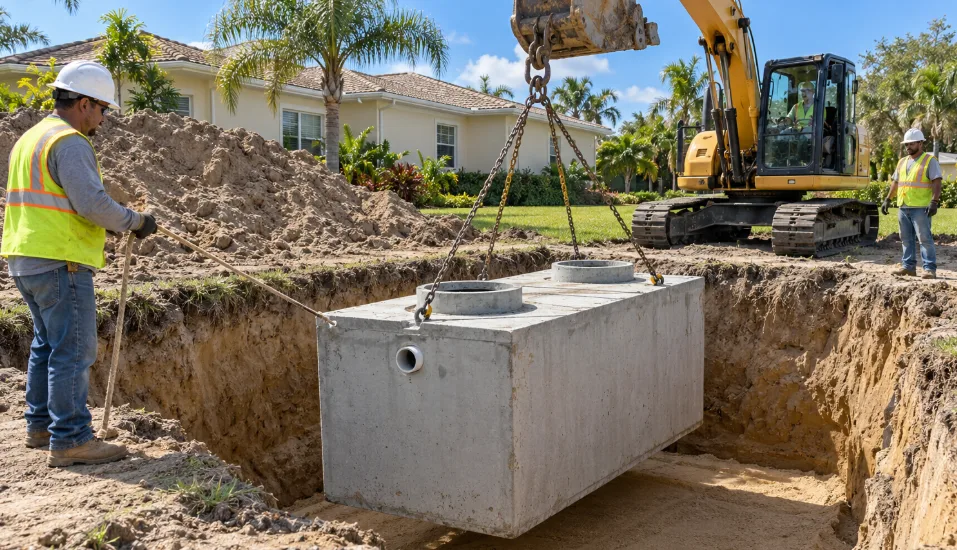
A tank can be sound while the field struggles. Review distribution, soil and groundwater before deciding on repair or replacement.
Assess distribution pipes, roots, damaged components and receiving soil before choosing a drain field repair. Separate a repairable defect from a disposal area that needs redesign or replacement.
Explore Drain Field ServiceReview field records, distribution, drainage symptoms and site constraints before a repair, property purchase or addition. Document observed conditions and the limits of the evaluation.
Explore Drain Field ServicePlan a replacement disposal area around usable space, soil, wet-season groundwater and current treatment requirements. Check sewer service before committing to a new field layout.
Explore Drain Field Service
The Lehigh Acres and nearby eastern Lee County communities Realtor.com listing series published by FRED reports a 1,661-square-foot median for September 2026. That is regional market context, not an average of all Lehigh Acres houses or a survey of septic-served homes.
Local new-home inventory also provides a useful example: D.R. Horton advertises a four-bedroom, two-bath, 1,828-square-foot layout in its Lehigh Acres spot-lot offerings. This is an example of a home layout, not proof that a particular listing uses septic or a measurement of the community’s average home.
County listing-size data · Local builder layout example
Florida considers both bedrooms and building area. A three-bedroom home around 1,661 square feet fits a 300-gallon-per-day flow example and a 900-gallon minimum effective tank capacity. A four-bedroom 1,828-square-foot example has higher demand from its bedroom count, even though its floor area is still below 2,250 square feet: the corresponding storage example is 1,050 gallons.
| Home example | Design flow | Minimum effective tank storage |
|---|---|---|
| 2 bedrooms, 1,100 sq ft | 200 gallons/day | 900 gallons |
| 3 bedrooms, 1,661 sq ft | 300 gallons/day | 900 gallons |
| 4 bedrooms, 1,828 sq ft | 400 gallons/day | 1,050 gallons |
| 4 bedrooms, 2,600 sq ft | 400 gallons/day | 1,050 gallons |
| A residential design at 401–500 gallons/day | 401–500 gallons/day | 1,200 gallons |
Derived examples from Florida Rule 62-6.008, Tables I and II. The more demanding bedroom or building-area criterion governs. These are storage minimums, not a final engineered design or a count of installed local tank sizes.
A 1,000-gallon installed tank can exist without being a universal Florida sizing rule. Use the approval record or a professional measurement to confirm the actual gallons. Treatment units, additional chambers and pump storage can increase the complete system volume; the drain field has its own sizing requirements.
DOH-Lee handles local septic permitting and inspections under Florida DEP rules. Lehigh Acres is in unincorporated Lehigh Acres and nearby eastern Lee County communities, so County building and plumbing approvals may also apply. Utility availability must be confirmed with the provider for the actual parcel.
DOH-Lee states that all new septic applications in unincorporated Lehigh Acres and nearby eastern Lee County communities require a Florida licensed professional engineer’s design, signed and sealed. The application also needs a site survey, floor plan, signed forms and site information. A septic construction permit is separate from a house building permit.
Read Lee’s new-system checklist
The observed paid-application review queue was about seven calendar weeks behind on October 28, 2026. Design work, missing documents, revisions, other approvals and inspections can add time. Obtain the actual permit before starting construction.
The live Review and Inspection Dates page listed paid septic applications from September 11, 2026 as under review—about seven calendar weeks behind the observation date. Application intake was working on emails dated October 27; revision intake on October 28. Initial and final inspection queues listed requests from October 12.
This is a dated workload snapshot, not a promised wait for your application, an approval deadline or the complete construction schedule. Check the live queue and the status of your complete, paid application before setting work dates.
Signed construction application, engineer’s signed and sealed design, site survey, labeled floor plan and site plan. Show structures, wells, easements, water lines, drainage, obstructions and the elevation reference. The survey must include nearby surface water and stormwater features within 75 feet of the lot.
Describe the failed system and proposed work. Include the existing-system/repair evaluation, original permit date, site plan and the requested water-use records: 12 months residential or 18 months commercial, unless served by a well. Confirm whether the proposed scope needs an engineer.
Show existing and proposed building and septic conditions. An added bedroom, increased demand or altered wastewater strength can change the review. Some additions without a new bedroom or system encroachment have a different existing-system review route; confirm eligibility with DOH-Lee.
New installation requirements · Repair requirements · Addition requirements
DOH-Lee’s published pages list a $390 new-system application fee, an additional $155 if a site evaluation is needed, a $465 performance-based application fee, and a $350 repair application fee. Confirm which route and charges apply; engineering, extra review or inspection, operating permits and County permits can be separate. Fees are not the same as our service prices.
The new-system page allows application packages by email to LeeEH@FLHealth.gov. The online service states that applications move to review only when complete and paid; approved permits are emailed to the address on the application. Use the portal for status, inspections and payment instructions rather than treating a payment receipt as approval.
| Route or stage | Timing guidance |
|---|---|
| County paid-application review queue | October 28 snapshot: reviewing September 11 paid applications, roughly seven weeks of observed lag. Recheck current dates. |
| Qualifying engineer-designed performance-based system | Section 381.0065(4)(l): 5 working days to request missing information; 15 after a complete application for issuance or a noncompliance notice and referral. |
| System repair application | Rule 62-6.015 directs the agency to make every effort to issue within two working days. This is an effort standard, not guaranteed approval or completed repairs. |
| General state application review | Usually a 30-day deficiency-notice period and a 90-day approval-or-denial clock after completeness, unless a shorter law applies. Proceedings and other statutory provisions can affect timing. |
An engineer’s signature on a new conventional design does not, by itself, place every application in the special performance-based review route. Ask which review applies. Separate County building work, utility coordination, installation, electrical work and final closeout can extend the total project schedule.
Engineer-designed review law · Repair rule · General review law
Check the actual lot’s utility service and mapped requirements before buying a system. Within affected BMAP, reasonable-assurance or pollution-reduction plan areas, new systems must use available sewer. Where sewer is unavailable, new systems on lots of one acre or less must use approved treatment achieving at least 65% nitrogen reduction, under section 403.067(7)(a)10. Confirm the parcel, current rule and application classification with DOH-Lee.
FGUA’s LEP 35 septic-to-sewer project describes study areas along Lee Boulevard, in census tract 403.05. A planned expansion is not confirmation that a sewer connection is available today. Request address-specific availability before committing to replacement.
LA-MSID requires permits for work that connects to, crosses or uses its drainage facilities or lands. Its published policy also identifies new or improved commercial, industrial and multifamily projects, and single-family parcels greater than one acre. Confirm district boundaries and the actual work; a septic permit does not grant a drainage easement or approval to alter a canal.
LA-MSID permitting policy · Lehigh Acres and nearby eastern Lee County communities building and permitting
Sludge and floating waste can escape the tank when maintenance is overdue and obstruct the field.
Running fixtures, concentrated laundry and changed property use can exceed the system’s demand allowance.
Grease, wipes and other waste can obstruct parts or interfere with treatment.
Heavy rain and high groundwater can reduce the soil’s ability to accept and treat wastewater.
Roots, broken pipes, paving and vehicle traffic can damage components or compact the disposal area.
A changed floor plan, failing pump, neglected blower or damaged controls can interrupt system performance.
A septic system is more than a tank. Its storage capacity, treatment process and drain field each do a different job. Use this guide to understand home size, tank materials, expected lifespan and Lehigh Acres conditions before choosing a service.
A regional listed-home median helps describe the market, but the actual floor plan controls septic planning. Bedrooms, building area, additions and property use must agree with the system’s approval. Two bathrooms do not automatically mean twice the tank storage of one bathroom.
The 1,828-square-foot, four-bedroom local layout is a good reminder: a compact four-bedroom home can require more design flow than a larger three-bedroom home. The more demanding bedroom or area calculation wins. Have the engineer review the actual plans.
Florida residential examples include 900 gallons for up to 300 gallons/day, 1,050 gallons for 301–400 gallons/day, and 1,200 gallons for 401–500 gallons/day. These are minimum effective storage examples, not an inventory of the most frequently installed tanks in Lehigh Acres.
An aerobic unit’s daily treatment rating is a different number from its physical tank volume. Additional chambers and pump storage can add gallons. The field must have enough approved area and suitable soil for the permitted flow. A bigger tank does not make saturated ground accept wastewater.
Use the existing permit record, tank approval markings or a professional capacity measurement to identify an installed system. Tell the service team when the capacity is unknown rather than guessing from the house’s appearance.
Heavy, rigid shells need appropriate lifting access and a prepared base. Covers, walls and seams deserve inspection for leakage or damage.
Lightweight composite shells need sound fittings, correct bedding and the approved manufacturer’s groundwater and backfill provisions.
Molded plastic construction needs correct burial, backfill and any required anchoring. Check for deformation and leaking connections.
The tank shell, soil-disposal area, pump and treatment equipment can age differently. Choose maintenance or replacement from condition, performance and the permitted scope. Product, installation, site conditions and care affect life; a material name is not a warranty or a mandatory replacement date.
A conventional tank settles solids before soil treatment. Aerobic equipment uses oxygen and often powered components. Performance-based systems target specified wastewater quality. DEP also lists approved in-ground nitrogen-reducing biofilters among enhanced-treatment options.
Tank material does not identify the treatment type, and adding an aerator alone does not prove 65% nitrogen reduction. Confirm the approved model, complete treatment train and ongoing servicing, operating permit or monitoring obligations for your system. Routine pumping is separate from a required construction upgrade.
Lehigh Acres and nearby eastern Lee County communities publishes separate wet- and dry-season water-table maps. Receiving soil can struggle when groundwater rises, even when the tank is sound. Site evaluation must establish the conditions for the actual parcel.
Wells, easements, structures and drainage features can limit where a field fits. The neighbor’s tank or house plan is not proof that the same layout will be approved on your lot.
District facilities need their own access and approvals. Filling an easement, redirecting runoff or building across district drainage is a separate issue from receiving a septic permit.
A backup soon after pumping can point to blocked outlets, damaged distribution, a failed pump or an unsuitable receiving area. Repeated pumping does not establish the cause.
Bedroom additions, room conversions and changed commercial use can exceed the approved demand. Compare the current layout with the permit rather than adding tank volume without a full review.
Pumps, blowers, alarms and controls need care according to their approved model. A power interruption or warning light needs diagnosis; do not repeatedly reset equipment or bypass treatment.
These are locally relevant checks, not a measured ranking of failures or a claim that every Lehigh lot has the same soil. Lee seasonal groundwater maps and a site-specific evaluation answer different questions.
Reduce water use and keep people and pets away from wastewater. Do not open or enter a tank. Emptying a tank in saturated ground can cause movement or flotation, so ground conditions must be assessed before pumping. Ask for professional help with an active overflow.
Practical answers for Lehigh Acres homes and businesses.
A matching three-bedroom, 1,201–2,250-square-foot Florida example uses 300 gallons/day design flow and 900 gallons minimum effective storage. Actual plans, approved treatment equipment and extra demand govern the complete system.
Florida uses the more demanding bedroom or building-area calculation. A four-bedroom 1,828-square-foot example uses 400 gallons/day and a 1,050-gallon minimum storage example.
DOH-Lee requires all new applications in unincorporated Lehigh Acres and nearby eastern Lee County communities to have a Florida licensed engineer’s signed and sealed design.
On October 28, 2026, the live portal listed paid applications from September 11 as under review—roughly seven calendar weeks of observed lag. Recheck current dates; completeness, revisions, special review routes and inspections affect your actual schedule.
DOH-Lee handles local septic permitting and inspections under DEP rules. County building, utility and LA-MSID drainage reviews may be separate requirements.
No. Confirm current address-specific availability with the utility provider. A planned expansion or feasibility study is not a connection approval.
No. Confirm parcel mapping, lot size, sewer service and application scope. New systems on lots of one acre or less in affected plan areas need approved treatment achieving at least 65% nitrogen reduction where sewer is unavailable.
EPA gives a general household interval of three to five years. Measured solids, occupancy, tank capacity and use determine the actual date. Advanced equipment has its own care requirements.
No. Availability, timing and service scope are confirmed separately. Reduce water use and obtain prompt professional help for active sewage overflow.
Tell us where you are, what is happening and the service you need.